
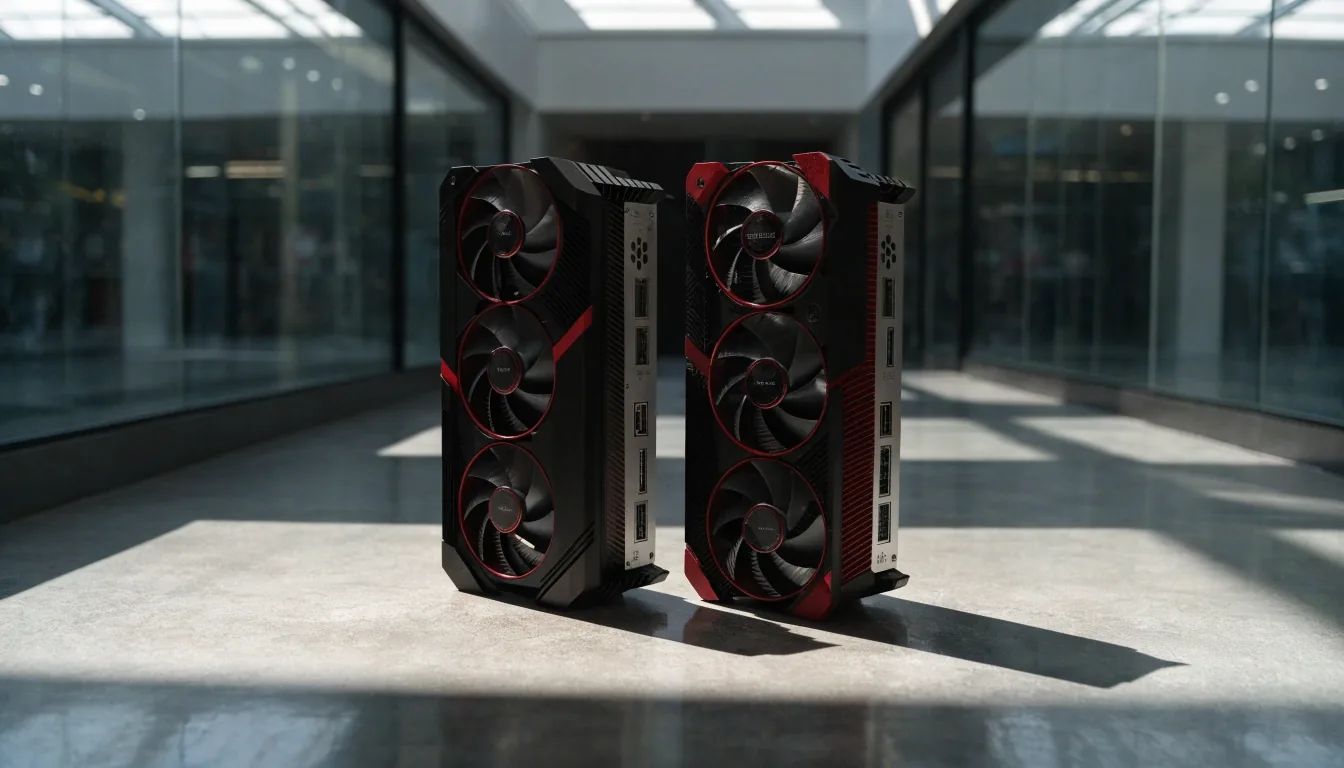
Two RTX 5090 Flagships, Side by Side
The ASUS ROG Astral RTX 5090 Edition 20 and the MSI GeForce RTX 5090 32G SUPRIM LIQUID SOC share the same Blackwell chip. What changes your build is how each partner handles heat, where the card sits, and how much room the cooling takes.
Check if these boards fit my caseWhat's the same, and why it matters
Both boards carry the RTX 5090 GPU, so raw frames land close. Both run the Blackwell architecture with GDDR7 memory, and MSI lists 32GB on its version. This is the part buyers skip: at this tier you are not choosing between a fast card and a slow one. You are choosing how the card behaves inside your case.
Cooling, footprint, noise, and power delivery are the levers that actually move. A board that fits, breathes, and stays tolerable under load will serve you longer than a spec sheet suggests. So we compare them on those four things, not on a benchmark number that both cards already clear.
Shared ground
ROG Astral
ASUS ROG Astral RTX 5090 Edition 20
SUPRIM Liquid
MSI GeForce RTX 5090 32G SUPRIM LIQUID SOC
ASUS Korea lists this under the ROG Astral family, ASUS's top-tier gaming line. The Edition 20 naming points to a special variant inside that lineup — limited-edition flagships draw attention in Korea even when performance stays close to standard premium boards.
MSI Korea lists this as a liquid-cooled RTX 5090 in the SUPRIM family, MSI's premium enthusiast line. The loop aims at lower temperatures and quieter running, and it suits showcase builds. Liquid cooling lands well in the Korean premium market, where smaller rooms and a taste for quiet, well-lit builds meet. The tradeoff is install: a pump and radiator to place, not just a card to slot.
A big heatsink needs intake and exhaust around it. Cases with mesh fronts and clear upper exhaust give an air-cooled flagship the room it wants, and the noise stays a known quantity.
The liquid board lives or dies on radiator placement. Top or front mounts with 360-class clearance let the loop do its job; a cramped bay with nowhere to hang the radiator undoes the advantage.
The Astral's Edition 20 label carries a collector argument. MSI's SUPRIM LIQUID SOC leans the other way — a regular flagship where the appeal is quiet, cool running and a clean look through a side panel.

Thermals and noise: what actually differs
Neither board wins outright. Air keeps things simple; liquid trades complexity for a quieter room.
Air-cooled flagship
A big heatsink and multiple fans move the heat, and you hear the result under load. The sound is predictable: a rise as the card works, a fall when it idles. Your case fans do part of the job too, so front-to-back airflow matters.
Liquid-cooled flagship
The loop sends heat to a radiator, which can run quieter at the same temperatures or hold lower temperatures at the same noise. How much depends on where the radiator sits and how much air reaches it. Set it behind a front intake and the fans have somewhere to push.
If your case has good airflow and you don't mind fan noise, air is simpler to live with. If quiet matters, or the build sits in the room you sleep in, liquid earns its complexity. Ask us and we'll match the choice to your room and case, not to a spec sheet.
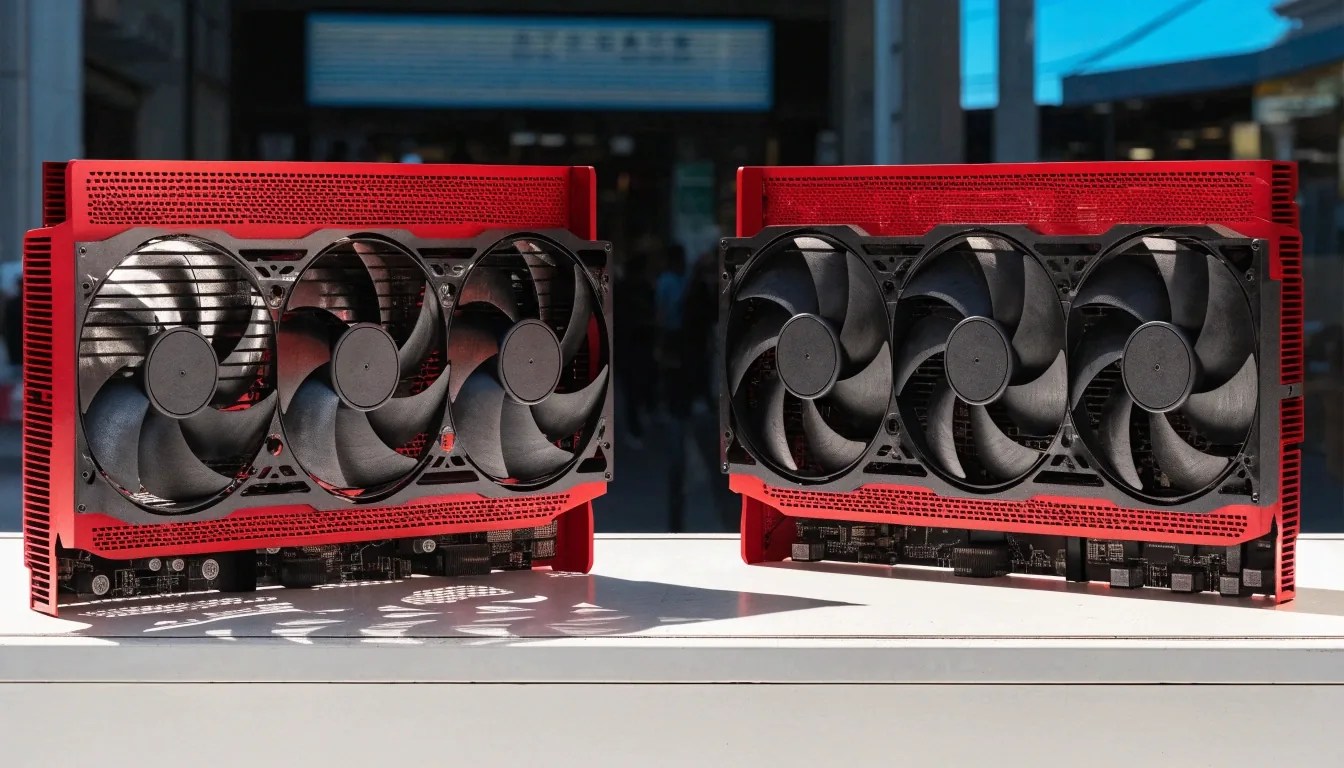
Build fit: size, slots, and power
Flagship 5090 boards are long and thick, and the liquid variant adds radiator and tubing routing to plan around. NVIDIA's RTX 5090 user guide calls for installation in a PCI Express x16 slot, the standard interface for modern discrete GPUs. From there, check power supply headroom for a flagship-class card and confirm case clearance before you commit.
This is where most first-time flagship builds run into trouble. The card is not the only thing with a size — the cables you bend behind it, the radiator you hang, and the drives you keep all compete for the same interior.
Card length
Measure from the slot to the front fan mount. Flagship shrouds overshoot the space a midrange card left behind, so a clearance check up front saves a return.
Slot thickness
Wide heatsinks block the slot below them. If you run a capture card or sound card, look at how many slots the shroud actually occupies.
Radiator space
The liquid board needs mounting points plus fan thickness plus room for the tubes to bend without kinking. Plan the tube run before you buy, not after.
Is the SUPRIM LIQUID SOC actually cooler than an air-cooled 5090? +
A liquid loop typically holds lower temperatures or matches air with less noise, but it depends on radiator placement and case airflow. The honest answer: it's built for quieter, cooler showcase builds, not for a guaranteed temperature gap in every setup.
Do both boards fit a standard ATX case? +
Not automatically. Flagship 5090 boards are long and thick, and the liquid version needs radiator space. Check card dimensions and radiator mounting points against your case, and confirm power supply headroom, before deciding.
Why does a limited-edition 5090 cost attention when performance is similar? +
At this tier, performance is close across premium boards. Buyers pay for edition rarity, presentation, and brand, which matters to collectors even when the GPU chip is identical. That's an aesthetic and ownership choice, not a performance one.
Which one should a first flagship build pick? +
If the case is airflow-forward and the install should be simple, the ROG Astral is the easier first flagship. If the room runs warm, the case has radiator mounts, and quiet matters more than simplicity, plan for the SUPRIM LIQUID SOC. Bring us the case model and we'll check the clearance either way.
Value over time
A flagship bought today tends to stay capable longer than a midrange card, which is part of the case for spending here if your budget allows. More VRAM and stronger throughput age better against heavier titles and creator work.
A limited-edition board's appeal is partly about the edition itself, not only performance. If you want the longest useful life and have the build to support it, the flagship tier is where that math works. If the case or the power supply is tight, work up to it — the upper-midrange tier still handles 1440p and 4K well.
Who should pick which
Choose the ASUS ROG Astral RTX 5090 Edition 20 if you want a top-tier air-cooled board, a special-edition presentation, and the simplest install. Choose the MSI RTX 5090 SUPRIM LIQUID SOC if you're building for quiet, lower temperatures, or visual impact and don't mind routing a loop.
Both are premium flagships; the decision is about your case, your noise tolerance, and how much you care about the edition angle. Give us your case model, where the build sits, and how loud the room already is, and we'll tell you which one we would put in it.